
Life as a Muslim Rapper in France
These translated excerpts are drawn from an oral history interview conducted with Sinik in Paris, France.
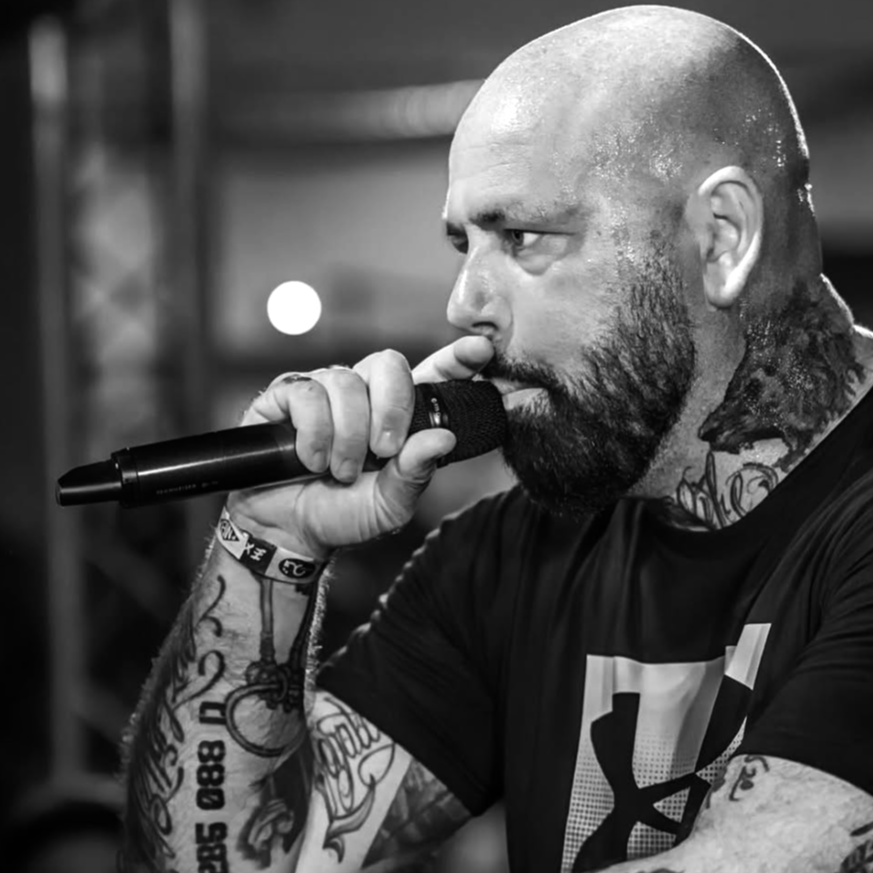
Sinik (born Thomas Idir in Paris in 1980) is a rapper of Algerian and French heritage. Raised in the housing estates of Les Ulis, south of Paris, he emerged in the late 1990s as part of the underground rap scene before launching a successful solo career. Known for his introspective writing, Sinik released nine studio albums between 2005 and 2022, several of which achieved gold or platinum status, establishing him as a significant figure in the French hip-hop scene.
Upbringing
“My father was born in 1945 in Algeria and was a child when he came to France. It was a generation that had to work hard from a young age. It was very difficult to arrive in France after WW2 – there was a real concern with integration, you had to be really discrete. To assimilate into French culture, especially in Post-War France, was hard. For me, it was simple. I had a French name, and in those days, I looked more French without the beard that I have now, and only my last name was Algerian. I lived in a neighbourhood that was extremely multicultural. It wasn’t until I got older that I was confronted by others about my identity.”
Being of Mixed Heritage
“Being French Algerian is a source of pride, it’s a real privilege to have two cultures. It gives me an open outlook on what is happening in France, Algeria and the rest of the world. It has helped me a lot. But as you get older you direct yourself towards one of those cultures more than the other. I’ve naturally directed myself to my father’s culture, it’s what spoke to me the most. I’ve also travelled a lot to Algeria from the age of twenty. It was so powerful the first time I went to Algeria… I was discovering it at a certain age where I could analyse, understand and make comparisons with what I was seeing in France at the time. I felt very good there – I can’t say better than France, but there was something that pleased me in Algerian life: the passion, anger, warmth, hospitality, the mentality.”
“I’m a Franco-Algerian, who in the way of living, being and doing, is closer to his Algerian side than French side. There is a side to France that is closed off, and I’m more Algerian in that I’m very open. Here, everyone looks at each other, no one speaks, neighbours don’t know each other – especially here in Paris. Maybe I feel more Parisian than French. In Paris there is a particular mentality.”
Life as a Muslim in France
“Today, it’s complicated to be a Muslim in France. Lots of political figures have added fuel to the fire. We are accused of everything that is happening to the world, especially terrorism. Bad people have used this to stigmatise the Muslim community. Every day in France, there is some kind of debate about Muslims on TV, especially in the lead up to elections. I have the impression that Muslims are more important than unemployment issues, living rights, etc. The veil in France is a real debate, what Muslim women wear to the beach, the anti-pork menus at school. It’s never to say good things, only to criticise. It weighs heavily on us and we feel very stigmatised. This is why we feel better abroad.”
“It’s a shame because France is a really beautiful country but it’s corrupted by this discourse that’s always anti-Muslim, anti-Islam, very islamophobic and it weighs heavily because we’re tired of being only represented by minorities who ultimately do not represent us at all. It’s a minority. I can speak to you about the IRA, the Basques, even Corsicans. In France, Corsicans are people who are fairly radical who defend their land. We don’t treat them the same way as we treat Muslims in France. And it’s normal. It becomes heavy, in fact, to live with this.”
“Eric Zyemour always talks badly about Muslims, but never about people like my parents who get up early in the morning to work, who pay their taxes. It’s unfortunate, and it’s a shame because our parents have always worked hard, been honest, tried to live, to assimilate – but their origins are always brought up when it goes bad. Because of these constant reminders that we are foreigners, that we are Muslims, we end up creating our own world and ultimately it’s two worlds that are completely different – that’s the problem. These two worlds aren’t compatible. I have a French mum, so if I do something good, they’ll say “he’s a French rapper”, but if I do something bad, I’ll be reminded of my Algerian origins.”
‘Douce France’
“Rap is a genre of music that challenges, that denounces things. It has a power to not just talk about love, like in all other French genres. Rap is more broad, you can talk about issues in more detail. Rap is a music of the banlieue - of banlieusards. My track ‘Douce France’ is inspired by a Charles Trenet song from the 1940s. It’s a political song that really summarises the situation in France. If I had commercialised it, I certainly would have had court cases. It was interesting to take on this concept and to transform it into rap, being able to show parallels with French culture and to criticise what is going wrong in our country. In this song, I talk about being Muslim, so it’s very representative of what’s happening in France.”