
Growing Up In Postcolonial France
These translated excerpts are drawn from an oral history interview conducted with Jarod in Paris, France.
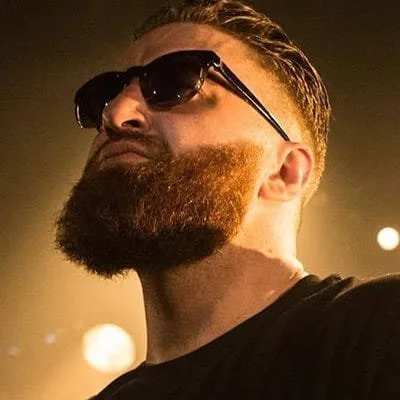
Jarod (born in 1987) is a French rapper of Algerian-Hungarian origin from Paris, where he grew up in the Cité des Orgues in the 19th arrondissement . A founding member of the group L’Institut and formerly affiliated with the Wati B label, he first gained recognition in the late 2000s through his freestyles before pursuing an independent career. Jarod has over 85 million views on his YouTube channel.
A Dual Identity
“My father is Algerian, my mother is Hungarian…half Hungarian, half Austrian. When I was young, I didn’t know where to position myself. I have two first names: one Karim, and the other Alexis. And since childhood, on my father’s side I was called Karim, and on my mother’s side I was called Alexis. So it’s like, from the very start, I had a double personality. When I was signed up for school, when it was my mother who would sign me up for school, she would write down ‘Alexis’. So I would go to school, the teachers they were... good with me. When I was with my father and he signed me up and I was called ‘Karim’, everything changed. And so it always created a certain schizophrenia in me. A double personality, bipolarity as we say. Because I never knew where to position myself and I didn’t feel French either.”
A Discriminatory Education System
“When you reach the end of your school cycle, you see someone who will guide you, that is to say, they will tell you what job you should go to. And I had good grades, so I could go for the Baccalaureate - for general subjects, mathematics, etc - I had the grades for that. But since my name was Karim, they told me to be a butcher or a plumber. It’s like that. The system creates castes. Arabs, Black people, we will push them more so that they remain at the bottom of the scale. The others will have access to studies.”
“We were told about the benefits of French colonisation in Africa. That is to say, we were told that colonisation was something good. That since France left Algeria and many African countries, Africa has sunk. That’s what we were taught in school. They don’t talk to us about the massacres, they don’t talk to us about the rapes, they don’t talk to us about the murders, sometimes even about the genocides. We weren’t told that in school books, history books. There is no such thing. This is why many African people are uprooted today.”
“Algerians, Malians, Senegalese, Tunisians, Moroccans, who are in France, we grew up at school and were taught that we were a second category of the population. So we grow up with complexes. So that is why we don't feel capable of succeeding, we don't necessarily feel capable of becoming doctors, of becoming… I don't know… astronauts. We grow up with a complex – we have no confidence in ourselves. And that's why in the end we end up doing things that aren't good, because we don't trust ourselves. We don't think we can do good, so we're going to do bad things. And we're going to comfort ourselves and and we're going to try to find the good in the bad. In any case, that's what I experienced, and around me, all the people I met – well, a lot of people I met, we grew up like that, with a lot of complexes, no confidence in ourselves.”
Being Muslim in France
“France, more than Anglo-Saxon countries, is a country where it is hard to be a Muslim. There is a real ferocity against Muslims – that is to say, they are really fighting Muslims. With the hijab, you can’t work in 80% of places, we'll watch you, we'll judge you... Here we tell you that you have to think like the French, you have to vote, you have to adhere to what they call laïcité - but it's not secularism in the sense that we tolerate all religions. It is more of a religion in itself.
Your religion you have to hide it. You have to keep it to yourself. Your origins… you can go to the country of your origins if you want to live like that. And that's the problem in France. It's that we don't give you the freedom to do what you want. You are imposed on in a certain way. So that's why it creates rebellion among young people.”