
A Pioneering Figure of French Hip-Hop
These translated excerpts are drawn from an oral history interview conducted with Freeman in Marseille, France.
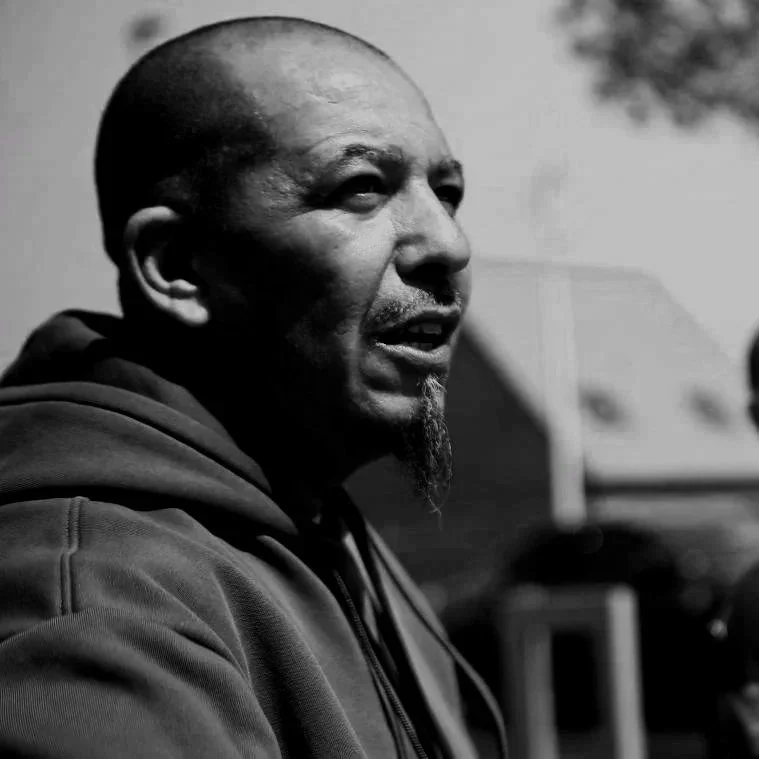
Freeman, also known as the ‘dinosaur of hip-hop’ for his influential role within the genre, was born in Marseille to Algerian parents. He rose to fame after joining the group IAM in 1989 – one of the founding collectives of French rap, whose track ‘Demain C’est Loin’ is widely considered to be one of greatest albums in the history of French rap. After almost two decades in the group, Freeman left IAM in 2008 and started a solo career, continuing to reinforce Marseille’s position as a critical counter-centre to Parisian dominance in French hip-hop culture.
Rap in the 1990s
“The rap scene really started for us as a group in the 1990s. Instead of writing at my house, I would go to the library. I always had a dictionary and all my books next to me. I self-educated myself like this. This is how I learnt and was able to speak to people. I was like Robin Du Bois [Robin Hood] but ‘Rebeu Du Hood’ [Arab of the Hood]...I’d steal intelligence from the libraries and transmit it to the youth from the quartiers.
We are street journalists. We don’t have qualifications, but thanks to music, I do something that no other worker can do: I combat eternity. My music will still be listened to in 200, 500 years insha’Allah. I’m here to combat eternity. We are leaving a trace. We have a huge opportunity to have a pen and to be listened to.
People in the day always had respect in Marseille; we thought of our elders. Gangsters would come to us and tell us to stop the bullshit – talking about drugs for example, they’d say, “talk to me about love.. your mum... your father, talk about good things, not bad things”. In Paris, it wasn’t like this. You have groups like NTM (Nique Ta Mère – Fuck Your Mother) for example. How can you say this? Knowing your mum will listen to this? For us it was inconceivable. For me, Paris has always been about a lack of respect.
For the older generation of rappers, we were much more engaged with our lyrics than young people today. It’s because of racism. It was another mentality back then, it was a racist environment. We used to chase away skin-heads, we’d clean up the area. We knew big gangsters; there were codes of honour. If we saw an old woman with bags, we’d go to help her. This doesn’t exist anymore. Now the young people, at the age of 15, they slap her and steal her bags.
We don’t like new rap because it reduces people. You say, “yeah I want a halal girl” – you? You want a halal girl? How are you living? We don’t speak of women like they do now. In the back of my mind, I had my mum, my sister. What would she think of me? Now they show alcohol, they insult the police. Before in the quartiers, we would rap to get out of their area. Now, young people are complacent in this shit. They say: “So what? I’m fine in the shit.” They are okay with living in the bad...”
Racism and Discrimination
“As Algerians, the relationship we have with France is very difficult. We still have a negative image: the robber, the profiter, the trafficker... even though my generation fought for this.. that we aren’t that. You’ll do 99 good things and one bad thing, but it’s the bad thing they’ll look at. In France we have this image of bad people.
I’m not out of Harvard, I only did 3eme, but 10 years later, but my texts are studied at the Sorbonne [university]. You’re studying my texts at universities. Is that not worth anything for you [France]? I’ve done conferences at universities. The only thing you can tell me though is “ah the immigrant” or “ah the guy from the hood”. When I was in IAM, our group was diverse... Italian, Malgash, Spanish, Senegalese, pieds noir.... very multicultural. But the racism was always aimed at me, ‘The Arab from the ghetto’. Why not to all the others? But I’m part of the generation of Rashid Taha’s ‘Douce France’ – you can’t respond to the bad with the bad, you have to prove the opposite.
Algerians have a lot of difficulty evolving in French society. For young Algerians who might be successful in university, they’ll be directed to manual labour. Those who can be doctors, engineers, even those who have Bac+10, they are working in MacDonalds. On the other side, Algerians say, “if you leave us in shit, we will make shit”. So there’s a parallel business in the quartiers. A young kid of twelve years old can make more than €3500 per month, when someone with Bac+10, engineer or doctor, can’t even make half of this. How can you tell these kids to start working [a legal job]? Even the youngest, the ‘chouf’ – those who do surveillance in the quartiers – they get paid for sending signals when they see the police arriving. What do you want us to do? Our parents came here, we were born here. I didn’t ask for this, I’ve suffered through this. But I can’t say entirely it’s the French state... we can’t put all the blame on one thing. It’s complex, it’s a mix of things. Insha’Allah we will do better.”
Identity as a Marseillais
“Here, they call me “dirty Arab”. When I go to the bled [homeland], they call me “immigri”. In Algeria they say, “you just come during the summer to show off your money” or use the term “harki” [soldier loyal to the French] as an insult, or say “you come to take advantage of our women”. You see, I have the ass between two chairs, so I’m Marseillais. I’m not French, I’m not Algerian, I’m Marseillais.”
His Track ‘Bladi’
“I was here but I lived it as if I was there. We would hear horror stories from family of violence. That’s what’s magic about music; this piece has become eternal. I wrote it on top of Notre Dame de la Gare and I was looking out to sea. When I did, I thought of the bled. I’m not there, but I’m still there. Other songs were more street, but this song was different. The concert in Cairo was extraordinary, it was something mystical. I have a Jewish friend who was in Israel at the time and they were all listening to Bladi in their car, shouting “shalom, shalom”. Subhan’Allah, what a crazy thing! I’ve never been there, and there I am in their car! Subhan’Allah.”